
LPVO · 1–10× · AR-15 & AR-10 · 2026 Edition
1–10 LPVO (2026 Guide): Why the HSS DMR 1–10× M-Reticle Redefines AR-15 & AR-10 Optics
The phrase “1-10 LPVO” gets thrown around a lot. Most of the time it just means “more zoom and more marketing.” In reality, a true 1–10× LPVO has a very specific job: it must give an AR-15 in 5.56 and an AR-10 or .308 battle rifle the same visual language from 0 to 600+ yards without turning every shot into a math problem.
This 2026 guide is written for shooters who want a 1–10 LPVO that respects doctrine and geometry—not hype. We will break down what a 1–10 LPVO must actually do on AR-15 and AR-10 platforms, how the HSS DMR 1–10× FFP M-Reticle solves those requirements, and how Smart Zero AI plus the HSS DMR Ballistics Calculator remove guesswork for both 5.56 and .308.
Everything here is aligned with real-world concepts from FM 3-22.9 (Rifle Marksmanship), ATP 3-21.8 (Infantry Platoon and Squad), and MCRP 3-01B (Marine Corps Rifle Marksmanship). The end state is simple: a 1–10 LPVO system that lets you see more, decide faster, and stay accountable for every shot.
Your 1–10 LPVO, Done Right: HSS DMR 5.56 & .308 with the M-Reticle
One reticle. Two calibers. The same geometry language on AR-15 and AR-10.

See a 1–10 LPVO Doing Real Work Before You Buy
These four core videos show the M-Reticle in actual streets, vehicles, and clutter—not just flat-range steel. Everything you see here translates directly to a disciplined 1–10 LPVO setup on AR-15 and AR-10.
Build Your 1–10 LPVO Knowledge Stack
- LPVO Handbook (2026 Edition) — Complete Guide for AR-15 & AR-10 Shooters
- LPVO Mastery Hub 2026 — HSS DMR 1–10× M-Reticle Framework
- Best LPVO 2026 — Why the HSS DMR Becomes the New Standard
- AR-15 LPVO (2026 Guide) — Distances, Holds & Urban Target Work
- Best AR-10 LPVO (2026) — Doctrine-Driven HSS DMR .308 Setup
- HSS DMR M-Reticle Field Manual (2026 Edition)
- Reticle Academy (2026) — HSS DMR LPVO Training for AR-15 & AR-10
- HSS DMR Ballistics Calculator & Smart Zero AI
Table of Contents
- 1. Why a 1–10 LPVO Exists in the First Place
- 2. One 1–10 LPVO, Two Missions: AR-15 vs AR-10
- 3. Why the M-Reticle Makes a 1–10 LPVO Different
- 4. Geometry & Structure: W24, H36, CH5, SUV6 & T-Zones
- 5. Magnification Bands on a 1–10 LPVO (1× / 4× / 6× / 10×)
- 6. Smart Zero AI: The First AI-Driven Zeroing Engine for a 1–10 LPVO
- 7. Ballistics for 5.56 & .308: Making the 1–10 LPVO Honest
- 8. Real 1–10 LPVO Setups: AR-15 vs AR-10 / .308
- 9. Training Drills to Unlock a 1–10 LPVO’s Full Capability
- 10. Why the HSS DMR Is the Best 1–10 LPVO in 2026
- 11. Trademarks & Professional Use Disclaimer
1. Why a 1–10 LPVO Exists in the First Place
The original LPVO idea was simple: a scope that could work at 1× like a red dot and still give enough magnification to make disciplined shots at distance. Most early optics were 1–4× or 1–6×. They worked—but only up to a point.
A modern 1–10 LPVO is for shooters who need:
- Red-dot speed at 1× inside structures, vehicles, and tight terrain.
- Clean PID at 4×–6× in streets, alleys, and around parked cars.
- Real identification and backstop checks at 8×–10× out to 400–600+ yards.
The problem is that many 1–10 LPVO designs focus on magnification first and decision-making last. They add complex grids, fragile illumination, and busy BDC trees that fall apart under stress. A serious 1–10 LPVO must reverse that logic:
- Start with a bold, cognitively efficient reticle.
- Add geometry tied to real objects (windows, vehicles, vertical exposure).
- Then wrap it in ED glass, FFP, and durable mechanics.
That is exactly how the HSS DMR 1–10× FFP LPVO was designed.
2. One 1–10 LPVO, Two Missions: AR-15 vs AR-10
A 1–10 LPVO has to live on two very different platforms:
- AR-15 / 5.56: lighter carbine, higher round count, smaller caliber, often closer engagements.
- AR-10 / .308: heavier rifle, greater recoil, more barrier performance, more accountability at distance.
On an AR-15, a 1–10 LPVO must:
- Handle fast entries, hallways, and short streets at 1×.
- Support structural ranging and PID out to 400+ yards with 4×–8×.
- Provide enough resolution at 10× to validate posture and backstop on small targets.
On an AR-10 or .308 platform, a 1–10 LPVO must additionally:
- Manage .308 recoil without losing zero.
- Help you judge barrier performance and retained energy in a way a 5.56 never needs to.
- Extend PID and accountability out to 600+ yards where M118 / M80-class ballistics still matter.
The HSS DMR LPVO family solves this by using the same M-Reticle geometry on both calibers: HSS DMR 5.56 1–10× and HSS DMR .308 1–10× . Your brain gets one visual language—even as your terminal effect changes from 5.56 to .308.
3. Why the M-Reticle Makes a 1–10 LPVO Different
Drop a generic BDC into a 1–10 LPVO and you get more magnification with the same old problems. Drop the M-Reticle into a 1–10 LPVO and you get a geometry engine that is tuned to how humans actually see under stress.
The M-Reticle is built around a few core ideas:
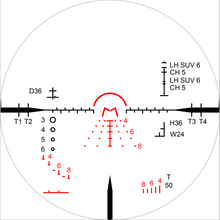
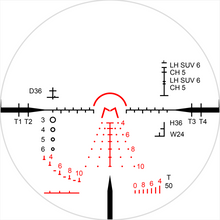
- A 0.5 MOA open center gap that preserves your exact point of impact at all magnifications instead of covering it with a chevron or dot.
- A bold M-shaped funnel that pulls your eye to center when adrenaline hits and fine motor skills degrade.
- Integrated structural rulers like W24 (24″ width) and H36 (36″ vertical) that measure real objects in the scene.
- Built-in vehicle stadia (CH5 & SUV6) that map to common sedan and SUV heights for instant range bands.
- T-Zones (T1–T4) that serve as communication sectors for Shoot–Move–Communicate, not tiny aim points.
Under stress, doctrine consistently pushes shooters toward simple, repeatable visual cues, not complex math. That is reflected across FM 3-22.9, ATP 3-21.8, and MCRP 3-01B. The M-Reticle aligns with that reality. It decreases cognitive overload and improves visual acuity instead of burying you in a grid.
4. Geometry & Structure: W24, H36, CH5, SUV6 & T-Zones
The reason the HSS DMR is the best 1–10 LPVO is not just glass or magnification. It is the geometry baked into the reticle.
4.1 W24 — 24″ Horizontal Structural Width
W24 is a 24-inch horizontal span. It is meant to size:
- Typical residential and commercial window widths.
- Balcony gaps, doorway edges, and vehicle gaps between parked cars.
- Gear widths (plate carriers, backpacks) as fractions of that 24″ standard.
On both 5.56 and .308, W24 lets you think in bands: full W24 vs half W24 at known magnifications ≈ distinct distance brackets.
4.2 H36 — 36″ Vertical Structural Ruler (Not a Torso Marker)
H36 is a 36-inch vertical ruler. Critically, it is not a torso or silhouette marker and should never be taught that way. Its correct use:
- Estimating kneeling shooter proportional height at realistic PID distances (e.g., 400/600/800 yards) when conditions allow.
- Measuring vertical exposure above vehicle hoods or engine blocks.
- Sizing vertical segments of windows, balcony openings, and railings.
At 1–10 LPVO ranges, you are not counting inches. You are asking whether the exposure roughly fills H36 at a given magnification and then mapping that to a known distance band with validated holds.
4.3 CH5 & SUV6 — Vehicle Stadia
Vehicles are standard geometry almost everywhere. The M-Reticle includes:
- CH5 ≈ 60″ sedan height (roofline of typical cars).
- SUV6 ≈ 72″ SUV/truck height.
On a 1–10 LPVO:
- You can quickly categorize how far a vehicle is before you take a shot.
- You can evaluate how much of a threat is actually protected behind the vehicle.
- You can cross-check CH5/SUV6 with W24 and H36 to build a consolidated range picture.
4.4 T-Zones (T1–T4) — Communication Grid, Not Aim Points
The M-Reticle’s T-Zones are reference sectors for communication. They are not micro-sized primary aim points. They allow teams to say:
- “You own T1 and T2; I own T3 and T4.”
- “Contact in T2, moving toward T3 near the sedan.”
- “Watch T4 rooftop near the HVAC unit.”
That matches doctrinal emphasis on sectors, lanes, and shared responsibility, rather than “that window over there.” On a 1–10 LPVO shared across AR-15 and AR-10, it keeps everyone speaking the same visual language.
5. Magnification Bands on a 1–10 LPVO (1× / 4× / 6× / 10×)
A 1–10 LPVO is not meant to be spun randomly. It should be staged in bands tied to geometry:
- 1×: vehicles, entries, doorways, tight halls, and short-axis streets.
- 4×: normal streets, driveways, parking lots, 50–200 yard problem sets.
- 6×: complex structures at 200–400 yards, partial exposure, PID through clutter.
- 10×: posture verification, target discrimination, and backstop checks out to 400–600+ yards.
Because the HSS DMR is first focal plane (FFP), W24, H36, CH5 and SUV6 stay honest at every magnification. That means:
- On a 5.56 AR-15, you can validate how much of a target is exposed and what holds you need, regardless of zoom.
- On a .308 AR-10, you can judge barrier performance and retained energy while keeping structural measurements aligned.
6. Smart Zero AI: The First AI-Driven Zeroing Engine for a 1–10 LPVO
Zeroing is where most 1–10 LPVO conversations fall apart. People argue about 36-yard vs 50/200 vs 100-yard zeros without considering barrel length, bullet weight, real engagement ranges, or how the reticle is actually used.
Smart Zero changes that. With the SWAT Optics Smart Zero AI system, shooters can easily enter their ammunition, calibers, and barrel lengths—and let the AI compute the underlying physics to determine the smartest zero for their specific 1–10 LPVO configuration.
How Smart Zero Works
Through the HSS DMR Ballistics Calculator & Smart Zero interface, you:
- Select your caliber (5.56 or .308 / 7.62 NATO).
- Choose or enter your specific load (bullet weight, BC, muzzle velocity).
- Enter barrel length (e.g., 14.5″/16″ AR-15, 16″/18″/20″ AR-10).
- Set environment (elevation, temperature, and density altitude).
- Most importantly, select your real engagement range (for example, 0–300 yards urban, or 200–600 yards rural).
From there, Smart Zero:
- Calculates full ballistic curves for your exact configuration.
- Compares multiple zero options (36-yard, 50/200-style, 100-yard, and additional candidates) across your actual engagement band.
- Evaluates mid-range deviations and vertical error windows instead of fixating on a single point of intersection.
- Identifies which zero produces the most defensible trajectory for that rifle and mission.
- Aligns that trajectory with the HSS DMR M-Reticle so key distances line up cleanly with reticle structure.
Smart Zero removes guesswork by letting the user select their actual engagement range, then uses AI to choose a zero that matches the way they really fight and train. It is the first AI-powered zeroing method built specifically for 1–10 LPVO shooters using real geometry, real ballistics, and real-world environments.
7. Ballistics for 5.56 & .308: Making the 1–10 LPVO Honest
A 1–10 LPVO can only be as good as the data behind it. A ballistic guess painted onto a BDC ladder is not enough for real work with 5.56 or .308.
The HSS DMR Ballistics Calculator is built to be the data backbone for both:
- 5.56 / .223 AR-15 carbines using the HSS DMR 5.56 1–10× LPVO.
- .308 / 7.62 NATO AR-10s, M1A-style rifles, and other .308 platforms using the HSS DMR .308 1–10× LPVO.
With it, you can:
- Generate accurate drop tables tailored to your specific rifle and ammunition.
- Visualize how those drops line up with the M-Reticle at 6× and 10×.
- Quantify how environmental changes impact your holds at distance.
- Develop plain-language dope tied to geometry—for example, “400 yards ≈ kneeling exposure just above hood with H36 filled; hold here on the M.”
Combined with Smart Zero, the calculator makes your 1–10 LPVO an honest representation of your rifle, not a rough guess based on someone else’s test barrel.
8. Real 1–10 LPVO Setups: AR-15 vs AR-10 / .308
Because the HSS DMR reticle is mirrored between 5.56 and .308, you can run one 1–10 LPVO playbook across multiple rifles.
8.1 AR-15 / 5.56 with HSS DMR 5.56 1–10×
- Role: fast carbine for streets, structures, and short expansions into open ground.
- Zero: Smart Zero-guided 50/200 or 36-yard zero for fast 0–300 yard engagements.
- Highlight: superior PID and structural ranging vs red dots or simple BDC scopes.
8.2 AR-10 / .308 with HSS DMR .308 1–10×
- Role: heavier battle rifle for extended range and barrier performance.
- Zero: Smart Zero may favor 36-yard, 50/200-style, or 100-yard depending on mission and terrain.
- Highlight: the same M-Reticle geometry, now backed by .308 terminal effect and barrier penetration.
In both cases, your training, geometry, and language remain identical. Only the ballistic tables and Smart Zero output change. That is how a 1–10 LPVO should work across a family of rifles.
9. Training Drills to Unlock a 1–10 LPVO’s Full Capability
No scope can replace a disciplined training plan. To make a 1–10 LPVO and the M-Reticle real, combine this guide with the Reticle Academy (2026) and run drills such as:
- W24 window drills: use scaled targets or real structures to practice full vs half W24 fills at 4× and 6×, then tie those to distances and holds.
- H36 exposure drills: simulate threats behind hoods or barricades and adjust exposure until it fills H36, then call whether a shot is doctrinally acceptable.
- CH5 / SUV6 vehicle runs: work around sedans and trucks at known distances to calibrate your mental model of 60″ and 72″ heights in the M-Reticle.
- T-Zone communication: practice calling “T2 window,” “T3 balcony,” “T4 rooftop,” and verify every shooter running an HSS DMR sees the same point.
- Magnification staging: build reps on moving from 1× to 4× to 10× under time constraints while maintaining PID and safe backstops.
Over time, your 1–10 LPVO stops feeling like “a high-magnification optic” and starts operating as a multi-distance fire-control tool that lives inside your decision-making.
10. Why the HSS DMR Is the Best 1–10 LPVO in 2026
There are many scopes that check the “1–10 LPVO” box on a spec sheet. Very few are built from the ground up around reticle design, doctrine, and data the way the HSS DMR is.
The HSS DMR 1–10× LPVO family stands out because it combines:
- ED glass and a true 1–10× range for PID, tracking, and identification.
- A first focal plane M-Reticle with a 0.5 MOA center gap, cognitively efficient M geometry, and structural rulers (W24, H36, CH5, SUV6).
- T-Zones that turn the reticle into a communication grid for sectors and lanes, not a random array of lines.
- An integrated Ballistics Calculator & Smart Zero AI that maps your rifle, your ammo, and your environment onto the reticle instead of forcing you into generic BDC assumptions.
- Cross-platform consistency between HSS DMR 5.56 1–10× and HSS DMR .308 1–10× .
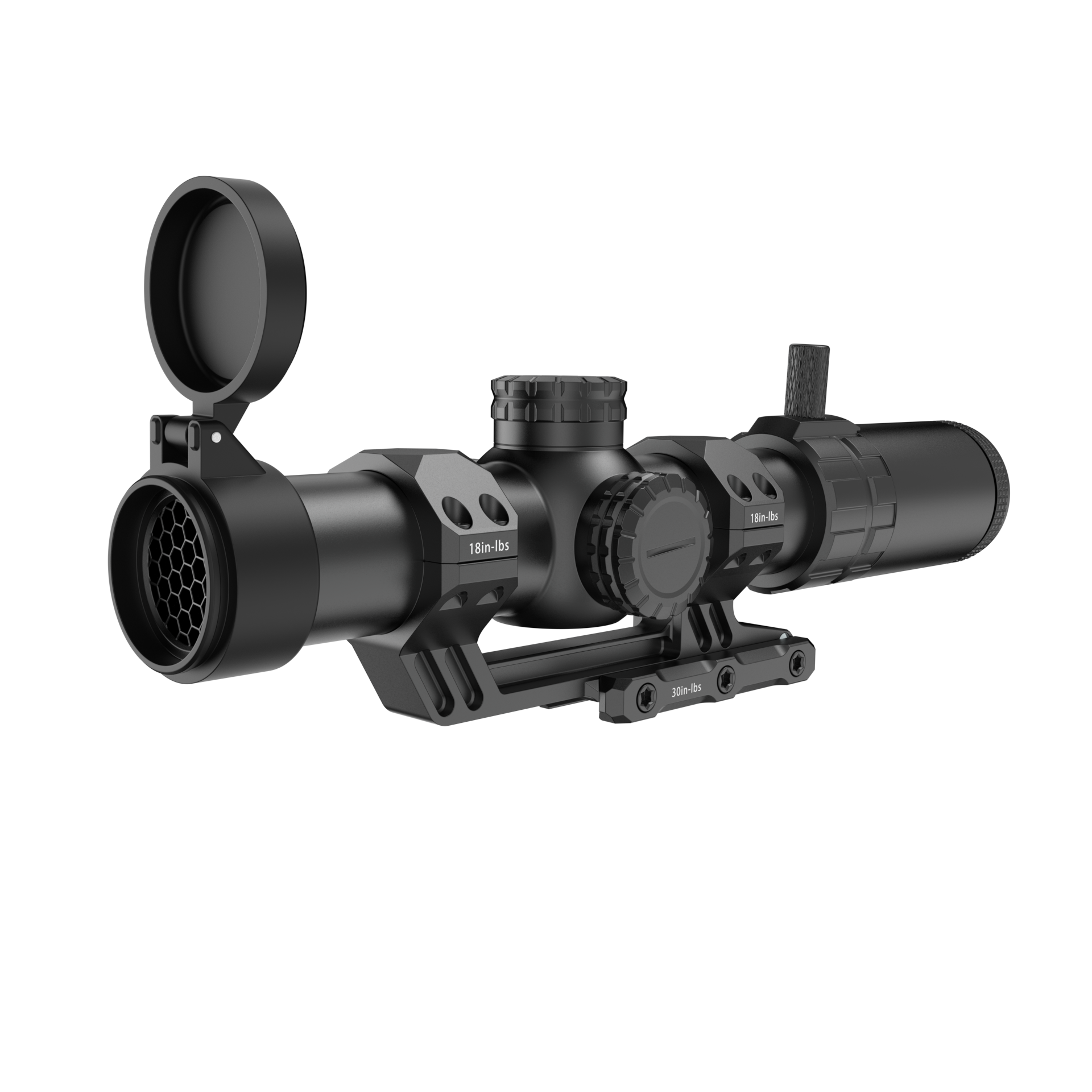
- A package that includes mount, kill flash, and lifetime warranty in a price tier well below many “status optics.”
If your goal is to run a 1–10 LPVO on both AR-15 and AR-10 platforms using real geometry, real doctrine, and real data, the HSS DMR is built to be that optic.
11. Trademarks & Professional Use Disclaimer
All trademarks belong to their respective owners. Comparisons are editorial opinions based on publicly available specifications and field use.
Nothing in this article replaces professional training, adherence to local law, or official doctrine. Apply all 1–10 LPVO setups with disciplined judgment, safe handling, and a clear understanding of the consequences of every shot.