

Doctrine-Informed Engineering
Military doctrine provides principles — observation discipline, use of cover, communication clarity, reduced cognitive load. The HSS DMR applies those principles to optic and reticle decisions in measurable ways. The result is a system designed for urban reality: vehicles, windows, partial exposure, and time pressure, where the limiting factor is rarely glass and almost always how fast the shooter can interpret and act.
Bullets are not lasers. They arc, drift, drop, and lose energy over distance. The M-Reticle is designed to help you measure what you can see — structures, exposure, vehicle context — and apply validated holds, without relying on electronics as a requirement.
Why the M Wins at Distance
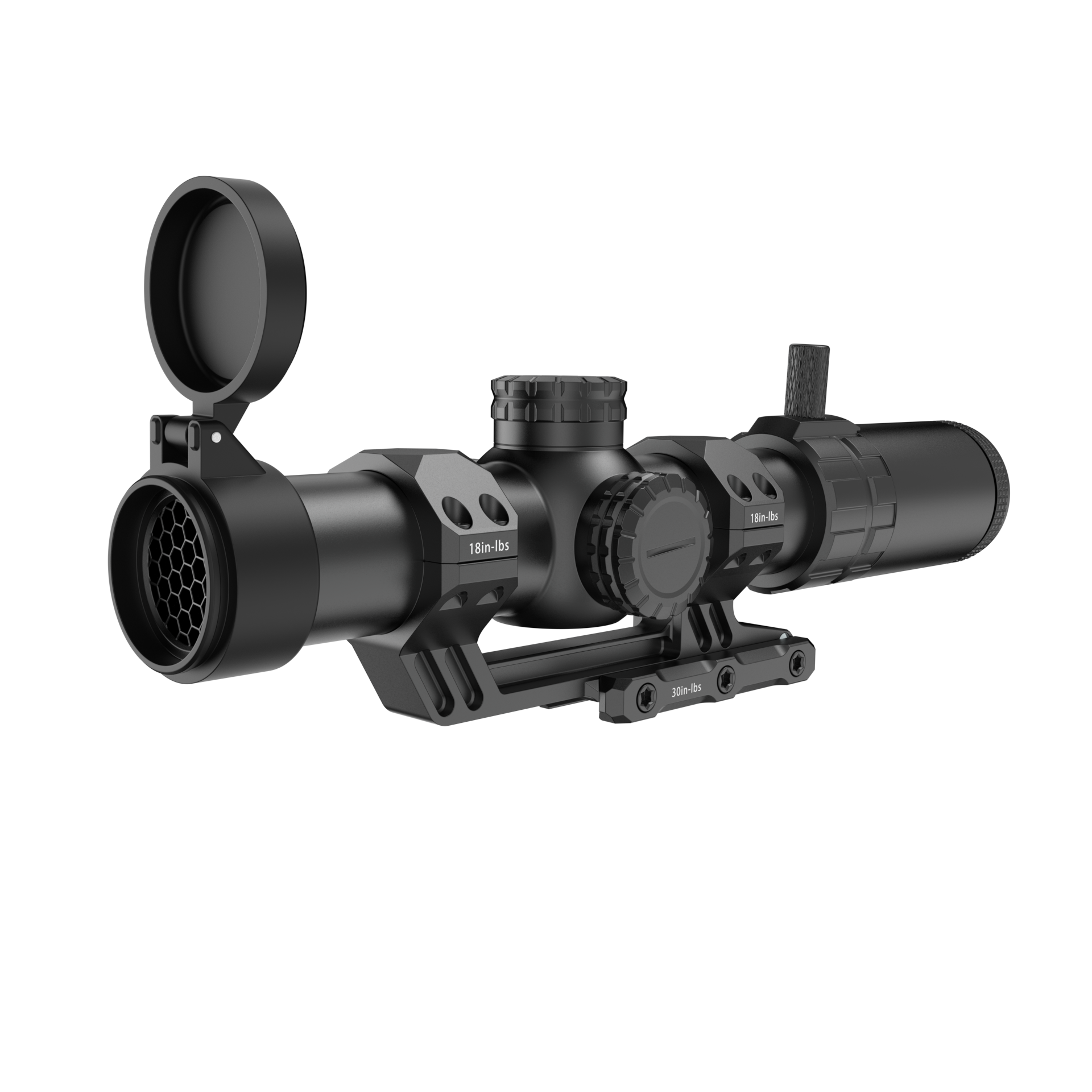
The HSS DMR is a true 1× LPVO. It can shoot at 1×. It is not, however, trying to win the red-dot fight. Inside 25 yards, nothing is faster than a red dot — the optical industry settled that argument decades ago, and we agree with the answer. A purpose-built CQB optic is the right tool for the close-quarters job.
The HSS DMR was built for a different job: unknown-distance engagements past the band where red dots and 1–6× LPVOs run out of resolution and ranging utility. SPR and DMR configurations. Real-world targets at real-world distances. The kind of shot where the limiting factor isn’t glass quality — it’s whether the shooter can read the situation, range it, and fire before the opportunity closes.
Those reticles are not wrong. They are excellent tools, optimized for their design conditions: crosshairs for known-distance precision from a stable position, chevrons for a balance of speed and target-clarity in the mid-band, red dots for unobstructed two-eyes-open speed inside 100 yards. Each makes design tradeoffs that pay off in the conditions it was built for.
The M-Reticle makes a different tradeoff, for different conditions. Instead of placing a mark on the target, the M creates a visual funnel that channels the eye to the aimpoint without occluding what the shooter is trying to read. The target stays visible. The reticle stops being an obstacle the brain has to work around, and starts being a structure the brain can use.
The funnel is also a ruler. The subtensions — D36 doorway width, H36 kneeling height, W24 window width, vehicle stadia, the T-50 torso reference — are calibrated to real-world objects: humans, hogs, deer, doorways, windows, vehicles. A shooter who can see the target can also measure it visually, without a rangefinder, without math, without a DOPE card pulled from a pocket. Smart Zero AI handles the zero math up front; the reticle handles the engagement math in the moment.
The design objective is first-round hit probability in unknown-distance situations where the conditions degrade gracefully — light fades, stress rises, range opens up — rather than failing at the edge cases. Vehicle interdiction. Wildlife management at field distances. Building-structure measurement for SWAT and rural LE applications. The kind of shot where the difference between a hit and a miss is measured in the half-second the shooter doesn’t have to spend fighting the reticle.


