
AR-10 · .308 · Zeroing Doctrine · DMR Optic · 2026
One Reticle.
Any Zero.
AR-10 LPVO Zeroing Doctrine — why 50/200, 36-yard, and 100-yard zeros each win in a different fight, and how to pick yours.
Most zero arguments are opinion. This one is anchored to TC 3-22.9, ATP 3-21.8, and MCRP 8-10B.2 — then applied to the HSS DMR .308 1–10× FFP LPVO, whose stadia are sized to the doors, windows, torsos, and vehicles you actually shoot around.
- No-Fault
Lifetime
Warranty - Geometry
Ranging - Doctrine
Informed - Made for
SPR / DMR - Scientifically Tested
400+ Trials
30-Day ReturnsNo-Fault Lifetime WarrantyDesigned in Texas
 HSS DMR .308 MOD M · 1–10× FFP LPVO
Watch the System Before You Zero
TIER 2 · TUTORIAL 1
Ranging Hidden Enemies: Windows & HVAC
PID and distance — doctrine’s first requirement before any shot
TIER 2 · TUTORIAL 2
Ranging Vehicles & Distance: Trucks
Vehicle stadia across the bands your zero has to cover
TIER 2 · TUTORIAL 3
Speed & Transitions on a 1–10×
Why a correctly zeroed LPVO replaces the dot-plus-magnifier stack
Videos load only when clicked, so the page stays fast on mobile data.
Most AR-10 zero discussions sound like campfire arguments: “50/200 is king,” “36-yard or nothing,” “100-yard is the only ‘precision’ zero.” None of that means anything if you don’t anchor it to doctrine and to what your optic actually does in real urban fights.
U.S. Army and Marine Corps marksmanship publications—TC 3-22.9 Rifle and Carbine and MCRP 8-10B.2 Rifle Marksmanship—all agree on the fundamentals: a proper zero gives you a predictable trajectory, a known point of impact, and confidence to apply holds under stress. ATP 3-21.8 Infantry Platoon and Squad then layers in the tactical reality—engagement areas, sectors of fire, and the need to rapidly service threats in complex terrain.
This article takes that doctrinal backbone and applies it directly to the SWAT Optics HSS DMR .308 1–10× FFP LPVO, showing why it’s the AR-10 LPVO that actually makes sense for 50/200, 36-yard, and 100-yard zeros in streets, vehicles, and barrier-heavy environments.
BLUF (Bottom Line Up Front): A .308 AR-10 with the HSS DMR 1–10×, zeroed correctly, gives you a doctrine-aligned “flat” trajectory zone, stadia that match real human and structural geometry, and holds that remain intuitive out to 600+ yards. Zero wrong, and you’re just sending expensive .308 into brick, bumpers, and bystanders.
Scope note: This page is educational. It is not legal advice, certified training, or use-of-force guidance.
Short answer. There is no single best AR-10 zero. Pick by the distance band you actually shoot:
- 50/200 yards — widest point-blank envelope. Best for mixed urban and suburban work inside roughly 300 yards.
- 36 yards — higher mid-range arc, second crossing further out. Best when 200–350 yard lanes are common.
- 100 yards — exact point of impact at a known distance. Best for barricades, loopholes, and partial exposures.
All three work with the same M-Reticle. The stadia are sized to real objects, so the relationship between reticle and target does not change when the zero does — only where the trajectory crosses the line of sight.
See the System First

Required Reading for AR-10 Shooters
Table of Contents
1. Doctrine: What the Manuals Actually Say About Zeroing
U.S. Army TC 3-22.9 for Rifle and Carbine zeroing, and USMC MCRP 8-10B.2 (formerly MCRP 3-01A) Rifle Marksmanship, both emphasize the same fundamentals: consistent position, natural point of aim, proper sight picture and a confirmed zero that provides a predictable trajectory for combat conditions.
TC 3-22.9 explicitly discusses stadiametric reticles and battlesight zeros, showing how stadia can be tied to vehicles and personnel at distance and how a properly chosen zero simplifies holds inside that battlesight window. ATP 3-21.8 then extends this to how squads and platoons fight—assigning sectors, covering likely avenues of approach, and building engagement areas where every rifle is expected to deliver hits on demand.
From a doctrine perspective, a “good” zero is not just a number—it’s a decision about where you want your trajectory to be forgiving:
- 50/200-style zeros emphasize a large point-blank envelope.
- 36-yard zeros bias earlier rise and flatter mid-range for urban lanes.
- 100-yard zeros favor precision at a fixed distance and clear glass holds.
The HSS DMR .308 LPVO is built to support all three approaches, but the optimal choice depends on your mission profile.
2. The AR-10/.308 Trajectory Problem (and Opportunity)
Compared to 5.56, a .308 AR-10 gives you:
- More mass and energy on target.
- Different drop curve and wind behavior.
- More recoil—any bad zero is punished harder.
Doctrinally, the manuals treat the ballistic path the same way: bullet leaves the bore below the optic’s line of sight, crosses the line once on the way up, rides above it for a while, then crosses it again on the way down. Your zero defines where those intersections sit relative to typical engagement distances.
For an AR-10 using quality 147–175 grain .308 or 7.62 NATO loads, the HSS DMR .308 LPVO is designed to keep:
- 0–250 yards in a “fast hit” envelope for urban fights.
- 300–600+ yards readable through the M-Reticle stadia without buried math.
- Consistent wind and elevation hold references that line up with the ballistic calculator curves.
Once you pick your zero, those stadia become your doctrinally correct angular reference system—just like the mils and MOA diagrams in TC 3-22.9, but tuned to the M-Reticle instead of a generic chevron or post.
3. The 50/200 Zero for AR-10: Battlesight in the Real World
The classic 50/200-style zero (where the bullet intersects line of sight around 50 and again near 200) serves the same purpose doctrine assigns to a battlesight zero: one sight setting that lets a shooter engage from close range out to a specified distance without significant hold adjustments. The Army’s own battlesight zero for the M4 is the 25m/300m setting in TC 3-22.9. 50/200 is a civilian refinement of the same principle, chosen because it puts the forgiving part of the trajectory where private-sector shooting actually happens.
Why it works so well for .308
- Out to roughly 225–250 yards (depending on load and sight height), your point of impact usually stays within a few inches of point of aim—perfect for torso-sized threats in streets, parking lots and open alleys.
- That lines up with the M-Reticle’s torso and shoulder-width stadia, letting you hold center-mass and trust the .308’s weight to do the work.
- In vehicle fights where targets appear between 25 and 150 yards, you don’t want mental gymnastics; you want “put the reticle where it needs to go and press.”
If your primary environment is mixed-distance urban & suburban with shots from bad-breath range out to around 300 yards, 50/200 on an AR-10 with the HSS DMR is extremely hard to beat.
Doctrine tie-in: At the platoon and squad level, ATP 3-21.8 expects riflemen to rapidly service threats inside engagement areas without needing a range card for every trash can and car bumper. A 50/200-style zero on a .308 AR-10 plus an intelligent reticle lets you do exactly that.
4. The 36-Yard Zero: Urban Lanes, Vehicle Corridors & Barrier Shots
The 36-yard zero is a near-zero: close enough to confirm on a short range, far enough that the bullet’s second crossing of the line of sight lands well downrange. It became popular in civilian practice for 5.56 because it produces a usable far zero without needing a long range to establish it.
On an AR-10 with the HSS DMR:
- A 36-yard zero often yields a slightly higher mid-range arc than a true 50/200 on .308, with the second intersection typically farther out than 200 (depending on ammo).
- This can be beneficial if your typical shots are in longer urban corridors—rail lines, long streets, wide river crossings—where 250–300 yard shots are common.
- Because the M-Reticle is structured around human and structural stadia, small increases in mid-range height are easy to manage—your visual “fit” on doors, windows and torsos quickly tells you how much to favor low or high.
If your environment is urban with frequent 200–350 yard shots—think long avenues, elevated positions, highway overpasses—a 36-yard zero can give you slightly better “on-plate” probability out there, while the stadia and ballistic calculator keep you honest.
5. The 100-Yard Zero: Precision, Glass and Partial Targets
A 100-yard zero aligns intuitively with most shooters’ mental model: “crosshair equals 100 yards.” It also pairs well with the type of precision shooting and barrier work described in advanced marksmanship portions of TC 3-22.9 and MCRP 8-10B.2, where precise POI at a known distance matters more than a broad battlesight envelope.
On an AR-10 with an HSS DMR:
- Glass shots through small openings, partial torsos behind pillars, and head-only exposures at ~100 yards are extremely intuitive—put the center where you want the round and press.
- At 200–300 yards you will deliberately use the M-Reticle’s elevation stadia and lateral references, which is perfectly compatible with the doctrine’s reliance on angular units (mils/MOA) rather than “guessing clicks.”
- For designated marksman style roles or heavy use of barricades and loopholes, this is compelling.
If your AR-10 role is more precision-leaning—supporting roles, overwatch, extended glass/barricade work— a 100-yard zero plus disciplined stadia use may be your best configuration.
6. Integrating the M-Reticle Stadia with Your Chosen Zero
Regardless of whether you choose 50/200, 36Y, or 100Y, the real advantage of the HSS DMR .308 LPVO is that the stadia are not random hashes—they are sized around:
- Human torso & head proportions.
- Door and window geometry in typical urban construction.
- Vehicle glass, pillars and width/height cues.
This is exactly how TC 3-22.9 describes “stadiametric” reticles—a system where vertical and horizontal lines reflect the apparent size of vehicles and personnel at known distances so soldiers can estimate range and make holds quickly.
Practical example with a 50/200-style zero
- From 0–200 yards, you hold center-mass using the main aiming point, trusting the battlesight envelope.
- At 300–400, you use the appropriate elevation stadia (confirmed in the ballistics calculator) and your visual-fit knowledge of how a torso or car window should look at that distance.
- Wind holds are applied using lateral stadia that are already “anchored” to human width or glass width, instead of arbitrary dots floating in space.
Each zero changes where those intersections land—but the relationship between M-Reticle stadia and the environment stays constant, which is exactly how doctrine wants you to think about angular units and target size.
The M-Reticle Geometry Stack
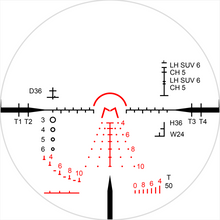
Measure the scene in layers — width, then height and exposure, then vehicle reference — and apply a validated hold. Each subtension is shown below against the target it was built to range.
- Interprets common widths: windows, structural segments, gear-width bands.
- Classifies a distance band quickly before you dial anything.
- Most reliable when paired to holds you have already confirmed.
- A 36-inch vertical ruler for kneeling height at distance and exposure above a hood or engine block.
- Not a torso or silhouette tool.
- Reads posture and exposure fast around vehicles and barricades.
- Sedan and SUV height references for roofline and hoodline reading.
- Converts vehicle clutter into measurable geometry and a comms anchor.
- Built for streets, driveways, lots, and parked vehicles.
- Measure, classify the band, confirm exposure, apply a pre-validated hold.
- On .308 this matters more because ranging error grows with distance.
- Under stress: less counting, faster decisions.
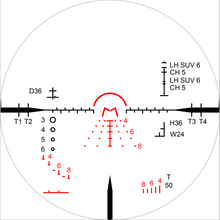
How to read it. D36 spans a 36-inch doorway. W24 spans a 24-inch window. H36 matches a kneeling figure at 36 inches; the full-height stadia matches a standing 5’10″ figure. LH SUV 6 and CH 5 bracket vehicle height at 400 yards, half-scale at 800. T-50 references a 500 mm shoulders-to-waist torso, and the head circle subtends 10 MOA. Frame the object, read the subtension, apply the hold.
The Decision Loop and T-Zone Sectors
Observe, Measure, Communicate, Engage — the loop the reticle is designed to compress under time pressure, with the T-Zone sectors used for callouts.
Rule: T-Zones are reference grid sectors for communication. They are not exact aim points. “Movement in T2” describes where to look, never where to hold.
What the Stadia Are Sized To
Each reference below is built around a real-world dimension, which is what lets a single zero carry across mixed distances.
Window
24-inch reference for openings. Building entry, SWAT, and rural LE structural assessment.
Doorway
36-inch reference for standard entry. SWAT and urban engagement structural measurement.
Kneeling Figure
36-inch reference for partial exposure. Hog, predator, and crouched-target engagement.
Vehicle
Full SUV/truck height to 400 yd. Vehicle interdiction, rural LE, ranch defense.
7. Using the SWAT Optics Ballistics Calculator for AR-10
Doctrine teaches the concept; the SWAT Optics Ballistics Calculator lets you pressure-test it with your specific ammo, barrel length and environment.
Open the calculator: SWAT Optics HSS DMR Ballistics Calculator and:
- Select your .308 / 7.62 NATO load (or input custom BC, velocity and bullet weight).
- Set scope height and chosen zero (50, 36, or 100 yards).
- Generate the trajectory table and note the drop/wind at 50–600 yards.
- Overlay those values mentally onto the M-Reticle stadia you saw in the videos above.
You’ll quickly see why the HSS DMR 1–10× was built around this doctrine-heavy view of LPVO employment: the reticle doesn’t fight your ballistic math—it visualizes it.
Smart Zero AI — Solving the Zero Before You Get to the Range
Inputs, evaluation, output, reticle alignment. Smart Zero AI ingests rifle, ammunition, barrel length, and environment, runs 366,000 calculations, and returns the zero that aligns the M-Reticle’s BDC marks with real yardage holds.
Illustrative example for an AR-10 with a 24-inch barrel running 178 gr Hornady ELD-M across a 100–600 yard band. Run your own numbers in the calculator, or see the AR-10 zeroing doctrine guide for the 50/200, 36-yard, and 100-yard treatment.
8. Instrumented Testing
SWAT Optics ran instrumented live-fire and human-factors testing on the M-Reticle system, measuring first-round hits, ranging time, time to first hit, follow-up split time, and physiological response. Participants ranged from Marines, Army veterans, and designated-marksman users to shooters with little prior precision-rifle experience. Every participant received the same familiarization briefing before measurement began.
50+ participants. 400+ recorded trials.
Scope of testing. Trials were conducted across the HSS DMR platform using 5.56 NATO, .224 Valkyrie, 6mm ARC, and .308 Winchester rifles. Results are reported for the M-Reticle system as a whole rather than for a single caliber or model.
Disclosure. Testing was conducted and documented by SWAT Optics. Results vary with shooter experience, rifle configuration, ammunition, target presentation, environment, and training. The comparative results have not yet been independently replicated. SWAT Optics supports independent testing using disclosed targets, procedures, timing definitions, and known-distance ground truth.
9. Zeroing FAQ
What is the best zero for an AR-10 .308?
There is no single best zero. A 50/200-style zero gives the widest forgiving envelope for mixed urban distances. A 36-yard zero pushes the second crossing further out, which suits longer lanes. A 100-yard zero gives an exact point of impact at a known distance for barricade and partial-target work. Match the zero to the distance band you actually shoot most.
Is a 50/200 zero the same as a military battlesight zero?
Not exactly. The Army’s battlesight zero for the M4 is the 25m/300m setting described in TC 3-22.9. A 50/200 zero serves the same purpose — one setting that covers a wide band without hold changes — but it is a civilian convention, not a doctrinal prescription.
Does a 36-yard zero work on .308, or is it a 5.56 idea?
It works, but it behaves differently. A 36-yard near-zero on .308 produces a slightly higher mid-range arc than a 50/200 and typically a second crossing beyond 200 yards, depending on load and sight height. Confirm the actual numbers for your ammunition rather than assuming 5.56 figures transfer.
How does scope height over bore change my zero?
A higher optic increases the angle between line of sight and bore, which pushes the first crossing out and raises the mid-range arc. On an AR-10 with a cantilever mount this is not trivial — enter your real measured height in the ballistics calculator instead of using a default.
Do I need to re-zero when I change magnification?
No. The HSS DMR is first focal plane, so subtensions scale with magnification and stay true at every power. That is the point of FFP for a measurement reticle — the ruler does not change size relative to the target.
What ammunition should I zero with?
Zero with the load you intend to shoot. The guide uses 178 gr Hornady ELD-M from a 24-inch 1:10 barrel as its worked example. Changing bullet weight or barrel length moves the trajectory enough to matter past 300 yards.
Can I use the M-Reticle stadia with any of the three zeros?
Yes. The stadia are sized to real-world objects — W24 window width, H36 exposure height, CH5 and SUV6 vehicle references. Those relationships are fixed by geometry, not by your zero. Your zero only determines where the trajectory sits relative to the line of sight.
How far out is the HSS DMR .308 usable?
The reticle is designed to keep 0–250 yards in a fast-hit envelope and 300–600+ yards readable through the stadia without external math. Beyond that, ranging error and wind dominate regardless of reticle design.
Do I need illumination for the stadia to work?
No. The M-Reticle is etched, so every reference stays readable with illumination off. Illumination helps in low light but the measurement system does not depend on it.
How many rounds should a confirmation take?
Zero on a stable position with a consistent hold, then confirm at a second distance before trusting the setting. Confirming at one distance only tells you the trajectory passes through one point — not that your understanding of the curve is right.
What warranty covers the HSS DMR?
A No-Fault Lifetime Warranty — your fault or ours, we fix it or replace it. Any cause, no time limit, fully transferable, no registration or receipt required. Exclusions are loss, theft, deliberate damage, and cosmetic wear that does not affect performance.
What is the return policy if the zero does not suit my setup?
Thirty days from delivery to request a return, on unmounted product in original packaging with all accessories and no markings. No restocking fee. The customer pays return shipping on change-of-mind returns.
Doctrine & Standards References
Doctrine is referenced conservatively for concepts and terminology only. Doctrine defines principles; it does not endorse products.
- U.S. Army marksmanship and small-unit concepts (terminology and principles referenced; non-endorsement)
- Core ideas used here: observation discipline, use of cover, communication clarity, reduced cognitive load under time pressure
Trademark Notice
SWAT OPTICS™, HSS DMR™, M-Reticle™, and Smart Zero AI™ are trademarks of Wizhunt Inc. All other trademarks belong to their respective owners. Comparisons are editorial opinions based on publicly available specifications and field use.