
AR-15 · 5.56 · SPR Optic · DMR Optic · 2026 Buyer’s Guide
Identify.
Range.
Engage.
The Best AR-15 LPVO in 2026 — why the HSS DMR 5.56 1–10× FFP dominates CQB, urban, and mid-range engagements.
Most AR-15 LPVO reviews obsess over glass buzzwords and illumination gimmicks. This guide asks the operational question instead: does the optic improve PID, range estimation, holds, and sector communication around structures, vehicles, and partial exposures at unknown distance?
- No-Fault
Lifetime Warranty - Geometry
Ranging - Smart Zero AI
- SPR & DMR
Ready - Scientifically Tested
400+ Trials
30-Day ReturnsNo-Fault Lifetime WarrantyDesigned in Texas
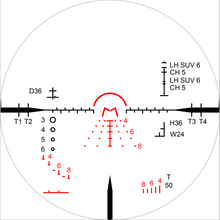 HSS DMR 5.56 MOD M · 1–10× FFP LPVO
BLUF · Bottom Line Up Front
The SWAT Optics HSS DMR 5.56 1–10× FFP was built from that requirement backward — a doctrine-aligned reticle architecture intended to reduce cognitive load and increase decision speed. It is not another 1–10×. It is a reticle-first system tuned around AR-15 ballistics and the geometry you actually see: streets, windows, door frames, vehicles, and partial silhouettes.
Watch the HSS DMR 5.56 in Real Engagement Scenarios
TUTORIAL 01
How to Range Vehicles & Distance: Trucks
Tutorial · Vehicle-sized targets
TUTORIAL 02
How to Range Hidden Enemies: Windows & HVAC
Tutorial · Ranging through structure
LIVE FIRE
Could You Use a Red Dot on Camouflaged Targets?
Live fire · Camouflaged steel
Videos load only when clicked, so the page stays fast on mobile data.
The System, End to End
Table of Contents
- Why the AR-15 LPVO decision matters in 2026
- What doctrine expects from your optic
- The M-Reticle: stadia built for AR-15 reality
- The geometry stack
- The decision loop and T-Zone sectors
- Zeroing, ballistics, and holds
- Urban, vehicle, and barrier engagements
- HSS DMR vs common LPVO reticle families
- AR-15 and AR-10 roles together
- Instrumented testing results
- Questions shooters ask
- Technical FAQ
- Doctrine and standards references
- About the author
1) Why the AR-15 LPVO Decision Matters in 2026
The AR-15 remains the dominant fighting carbine because it is fast, controllable, and mechanically forgiving — until you bolt on an optic that forces you to waste time. The wrong LPVO turns a capable rifle into a liability: cluttered sight picture, weak PID, no practical way to estimate distance under pressure, and hold marks calibrated to one brochure load in one atmosphere.
A duty-capable AR-15 LPVO in 2026 has to support four realities at once:
- Near speed: 1× behavior that does not punish you at room distance.
- Midrange decisiveness: fast PID and holds where most real shots occur, 100–400 yards.
- Unknown-distance competence: a repeatable method for estimating distance without electronics.
- Low-power resilience: usable aiming even if illumination fails or the battery is removed.
Most optics deliver one or two. The gap between them is where the HSS DMR 5.56 1–10× FFP was designed to live.
2) What Doctrine Expects from Your Optic
A doctrine-driven optic is not a slogan; it is a design constraint. Army and Marine publications consistently emphasize fundamentals, observation, range estimation, and practical engagement tasks. The optic should reduce the number of steps between observation and decision, not add steps.
What marksmanship fundamentals imply for LPVO design
- Observation and identification: the reticle cannot obscure critical visual detail — hands, weapons, angles, background.
- Range estimation: the shooter must estimate distance using known reference sizes and appearance cues.
- Repeatable holds: a consistent hold language that survives stress and imperfect conditions.
What platoon and squad problems imply
- Sectors and lanes: the sight picture must help you communicate and deconflict responsibility.
- Urban movement and barriers: real targets appear partially — shoulders, heads, weapons — not as clean silhouettes.
- Vehicles as cover: the optic must help interpret threats around hard cover where rangefinding is difficult.
Operational framing: the goal is not to win reticle arguments. It is to reliably perform the doctrinal tasks — PID, range estimation, holds, sector communication — when targets are partial, time is short, and the background is not clean.
3) The M-Reticle: Stadia Built for AR-15 Reality
Most AR-15 LPVO reticles fall into four buckets: simple illuminated dots, chevron and BDC hybrids, dense MIL grids, or competition patterns that assume predictable targets. The M-Reticle treats the reticle as a decision system built around what you actually see.
Visual-fit ranging, not math as the primary pathway
Under stress, multi-step range equations are fragile. Visual-fit ranging compares what you see — a door, a window segment, vehicle height, partial torso exposure — against calibrated references in the reticle. That matches how the brain already evaluates size and distance.
- Torso fit: partial exposures become measurable rather than guesswork.
- Structure fit: door and window edges are everywhere in real streets, so the reticle treats them as distance cues.
- Vehicle fit: vehicles are frequent hard cover, and their consistent dimensions become range anchors.
Because the HSS DMR is first focal plane, those relationships hold through the zoom range. Your reference meaning does not move as magnification changes.
Design principle: preserve central clarity for PID while still providing reference structure for speed. Heavy chevrons and large center blobs hide the very detail doctrine requires you to confirm before pressing a trigger.
4) The Geometry Stack
Every subtension maps to a real object. The diagram below shows each reference against the target it was built to measure.
How to read it. D36 spans a 36-inch doorway. W24 spans a 24-inch window. H36 matches a kneeling figure at 36 inches; the full-height stadia matches a standing 5’10″ figure. LH SUV 6 and CH 5 bracket vehicle height at 400 yards, half-scale at 800. T-50 references a 500 mm shoulders-to-waist torso, and the head circle subtends 10 MOA.
5) The Decision Loop and T-Zone Sectors
Observe, Measure, Communicate, Engage — the loop the reticle is designed to compress under time pressure.
Rule: T-Zones are reference grid sectors for communication. They are not aim points. “Movement in T2” describes where to look, never where to hold.
6) Zeroing, Ballistics, and Holds
Smart Zero AI handles the zero math before you leave the house. It runs 366,000 calculations against your specific scope, load, barrel length, and environment, then returns the zero that aligns the M-Reticle’s geometry to your rifle rather than to an average one. But the fastest reticle still fails if the shooter never confirms the system with real data.
Zeroing philosophy
- 50/200-style zero for general-purpose rifles prioritizing speed across common distances.
- 100-yard zero when you want explicit holds and training consistency.
- Custom zero when your priority is your specific load, barrel length, and environment.
Why one-size BDC drifts
Most BDCs are calibrated around a single assumed muzzle velocity, bullet weight, and atmospheric profile. Change any one and the “400” mark is no longer 400. The HSS DMR approach is to validate your actual profile first, then treat the reticle as a repeatable reference system rather than a marketing promise.
Smart Zero AI — Solving the Zero Before You Get to the Range
Rifle, ammunition, barrel, and environment evaluated in parallel, returning the zero that aligns the M-Reticle’s geometry to your specific build.
Illustrative example for an AR-15 with an 18-inch 1:7 barrel running 77 gr OTM. Run your own numbers in the calculator — it is mobile-friendly and needs no app install.
7) Urban, Vehicle, and Barrier Engagements
This is where the HSS DMR 5.56 differentiates most clearly. Urban and vehicle environments are not range day: partial exposures, hard shadows, uneven backdrops, and a requirement to observe and identify before committing.
Vehicles as cover and geometry
- Threats are partial: shoulders and heads appear around pillars, wheels, and hoods.
- Distance is ambiguous: a vehicle in a street can be close or far depending on perspective.
- PID matters: the reticle must not block hands, objects, or the background context you need.
The M-Reticle is calibrated to measure those exact objects. Each illustration shows a subtension against the target it was engineered to range — the bracket draws itself, and the figure moves the way it would in the field.
Window
24-inch reference for openings. Building entry, SWAT, and rural LE structural assessment.
Doorway
36-inch reference for standard entry. SWAT and urban engagement structural measurement.
Kneeling Figure
36-inch reference for partial exposure. Hog, predator, and crouched-target engagement.
Vehicle
Full SUV/truck height to 400 yd. Vehicle interdiction, rural LE, ranch defense.
Each of these shares a property: the target is partly hidden, and what you can see is a structure of known size. A doorway is 36 inches. A window is 24. A sedan roofline sits at a predictable height. When the reticle is calibrated to those objects, concealment stops being an obstacle and becomes the measurement.
Practical objective: red-dot speed at 1× is not enough on its own. A credible AR-15 LPVO must also deliver doctrine-level information at 6–10× without turning the sight picture into clutter.
8) HSS DMR vs Common LPVO Reticle Families
The fair comparison standard is not which reticle looks best. It is which family makes the doctrinal tasks easier under pressure.
| Capability | Chevron / Basic BDC | Dense MIL Grid | HSS DMR 5.56 M-Reticle |
|---|---|---|---|
| CQB speed at 1× | Fast, but the center can obscure detail | Often slower; center clutter dominates | Fast aiming with preserved center visibility |
| PID at 150–400 yards | Depends heavily on center-mass coverage | Grid interferes with reading hands and weapons | Architecture prioritizes readable detail |
| Unknown-distance ranging | Usually limited; assumes known distance | Possible but training and time intensive | Designed for rapid visual-fit estimation |
| Urban and vehicle | Not typically built around vehicles or barriers | Usable but cognitively heavy under stress | Built for lanes, vehicles, barriers, partial exposure |
| No-battery survivability | Etched works, but ranging may be weak | Etched works; complexity remains | Etched FFP; designed for visual-only operation |
Force the comparison to be about real tasks and the question changes from which LPVO is cheapest to which one gives your AR-15 the most capability without adding failure points.
9) AR-15 and AR-10 Roles Together
Your AR-15 with the HSS DMR 5.56 is the agile rifle: speed, control, and practical performance where most engagements occur. Heavier roles — intermediate barrier performance, extended energy, designated marksman work — are AR-10 territory.
The matching system optic is the HSS DMR .308 1–10× FFP LPVO, and the platform-specific doctrine page is the AR-10 urban engagement guide.
Running both platforms with consistent reticle language removes retraining overhead: same visual logic, different ballistic envelopes.
Both optics ship with the one-piece cantilever mount, integrated kill flash, throw lever, front and rear flip caps, lens cloth, and CR2032 battery — and both carry the No-Fault Lifetime Warranty: any cause, no time limit, fully transferable, no registration or receipt required. Returns are 30 days on unmounted product in original packaging, with no restocking fee. Every HSS DMR is designed in Lewisville, Texas.
10) Instrumented Testing
SWAT Optics ran instrumented live-fire and human-factors testing on the M-Reticle system, measuring first-round hits, ranging time, time to first hit, follow-up split time, and physiological response. Participants ranged from Marines, Army veterans, and designated-marksman users to shooters with little prior precision-rifle experience. Every participant received the same familiarization briefing before measurement began.
50+ participants. 400+ recorded trials.
Scope of testing. Trials were conducted across the HSS DMR platform using 5.56 NATO, .224 Valkyrie, 6mm ARC, and .308 Winchester rifles. Results are reported for the M-Reticle system as a whole rather than for a single caliber or model.
Disclosure. Testing was conducted and documented by SWAT Optics. Results vary with shooter experience, rifle configuration, ammunition, target presentation, environment, and training. The comparative results have not yet been independently replicated. SWAT Optics supports independent testing using disclosed targets, procedures, timing definitions, and known-distance ground truth.
11) Questions Shooters Ask
The objections that come up most, answered directly.
Is 1–10× too much magnification range for an AR-15 LPVO?
Not if the reticle stays readable at 1× and the holds stay usable at the top end. The practical failure mode of high-range LPVOs is rarely magnification — it is reticle design, center obstruction, and a sight picture busy enough to slow PID and decision-making.
What makes an LPVO “doctrine-driven” instead of marketing-driven?
A doctrine-driven LPVO prioritizes the tasks a shooter actually performs: PID, distance estimation, practical holds, and sector communication, especially around structures and vehicles. Marketing-driven optics emphasize buzzwords without improving any of those.
Do I need a ballistic app for the M-Reticle to work?
No. The calculator confirms and refines your holds, but an etched FFP reticle stays functional without electronics. The point is repeatability: confirm on steel, then build the muscle memory.
Is a BDC reticle bad for an AR-15?
Not inherently. A BDC works when it closely matches your actual muzzle velocity, bullet weight, and environment, and you have confirmed it at distance. The limitation is that basic BDCs rarely help with unknown-distance ranging or vehicle and structure distance cues.
Which matters more: glass quality or reticle design?
Both matter, but for decision speed around vehicles and partial exposures, reticle architecture usually determines whether the shooter can act quickly without losing PID detail. Excellent glass behind a reticle that blocks information still fails the doctrinal tasks.
How does the AR-15 model relate to the AR-10 version?
Identical reticle geometry, different ballistic envelope. Running both platforms with the same visual language removes retraining overhead — the subtensions mean the same thing on either rifle.
12) Technical FAQ
What barrel length does the HSS DMR 5.56 need?
16 inches minimum, 20 inches preferred, with match-grade ammunition. The reticle geometry is calibrated to high-BC match loads rather than an average of common ammunition.
What turret adjustments does it use?
Capped MOA turrets with 0.5 MOA adjustments. That is standard for the LPVO class; the 0.25 MOA figure often cited as an industry standard applies to precision and target scopes.
Is the HSS DMR 5.56 a true 1×?
Yes. At 1× it functions as a true red-dot-style sight with both eyes open.
Is it night-vision compatible?
Yes.
What is an SPR optic versus a DMR optic?
Both describe a role rather than a fixed specification. An SPR optic supports a Special Purpose Rifle sitting between a standard carbine and a dedicated precision system — historically a 5.56 platform. A DMR optic supports the designated marksman role, engaging past the typical squad band.
What is H36 used for?
H36 is a 36-inch vertical structural ruler used to measure kneeling shooter height at distance and to assess exposure above a vehicle hood or engine block. It is not a torso or silhouette measurement tool.
Are T-Zones aim points?
No. T-Zones are reference grid sectors for communication — Shoot, Move, Communicate. They are not exact physical aim points on the scope.
What warranty covers the HSS DMR?
A No-Fault Lifetime Warranty. If the optic is damaged or defective, SWAT Optics repairs or replaces it regardless of cause, with no time limit. Fully transferable, no registration or receipt required. Exclusions: loss, theft, deliberate damage, and cosmetic wear that does not affect performance.
Does it run cartridges other than 5.56?
Yes, depending on the build. High-BC chamberings such as 6.5 Grendel and 6mm ARC work; the Ballistics Calculator determines the correct zero for your specific load and barrel.
What is included in the box?
The scope, a one-piece cantilever mount with integrated kill flash, front and rear flip-up lens caps, throw lever, lens cloth, and a CR2032 battery.
Doctrine & Standards References
Doctrine defines principles and employment concepts. It is not a product endorsement. These references are provided conservatively to support discussion of PID, range estimation, small-unit sectors, and engagement decision-making.
- ATP 3-21.8 — Infantry Platoon and Squad. The doctrinal framework for small-unit employment, sectors, and urban movement.
- TC 3-22.9 — Rifle and Carbine. The Army training circular commonly referenced for rifle marksmanship instruction.
- MCRP 3-01A — Rifle Marksmanship. Marine Corps reference publication for rifle marksmanship.
On performance language. Words such as “best,” “outperforms,” and “dominant” are editorial conclusions, not universal facts. Where possible they are paired with testable criteria: PID clarity, repeatable holds, ranging workflow, training time, and observed results on steel. The FFP claim — that subtensions stay consistent across magnification — is a standard optical principle; the on-range benefit depends on training and confirmation.
Safety & Use Disclaimer
Always use firearms and optics responsibly and in accordance with all applicable laws. Nothing on this page is legal advice, use-of-force guidance, or certified training. This content is educational only. Verify your own zero, holds, and ammunition performance on the range with your rifle and optic before relying on any concept here in a defensive context.
Trademark Notice
SWAT OPTICS™, HSS DMR™, M-Reticle™, and Smart Zero AI™ are trademarks of Wizhunt Inc. All other trademarks belong to their respective owners. Comparisons are editorial opinions based on publicly available specifications and field use.