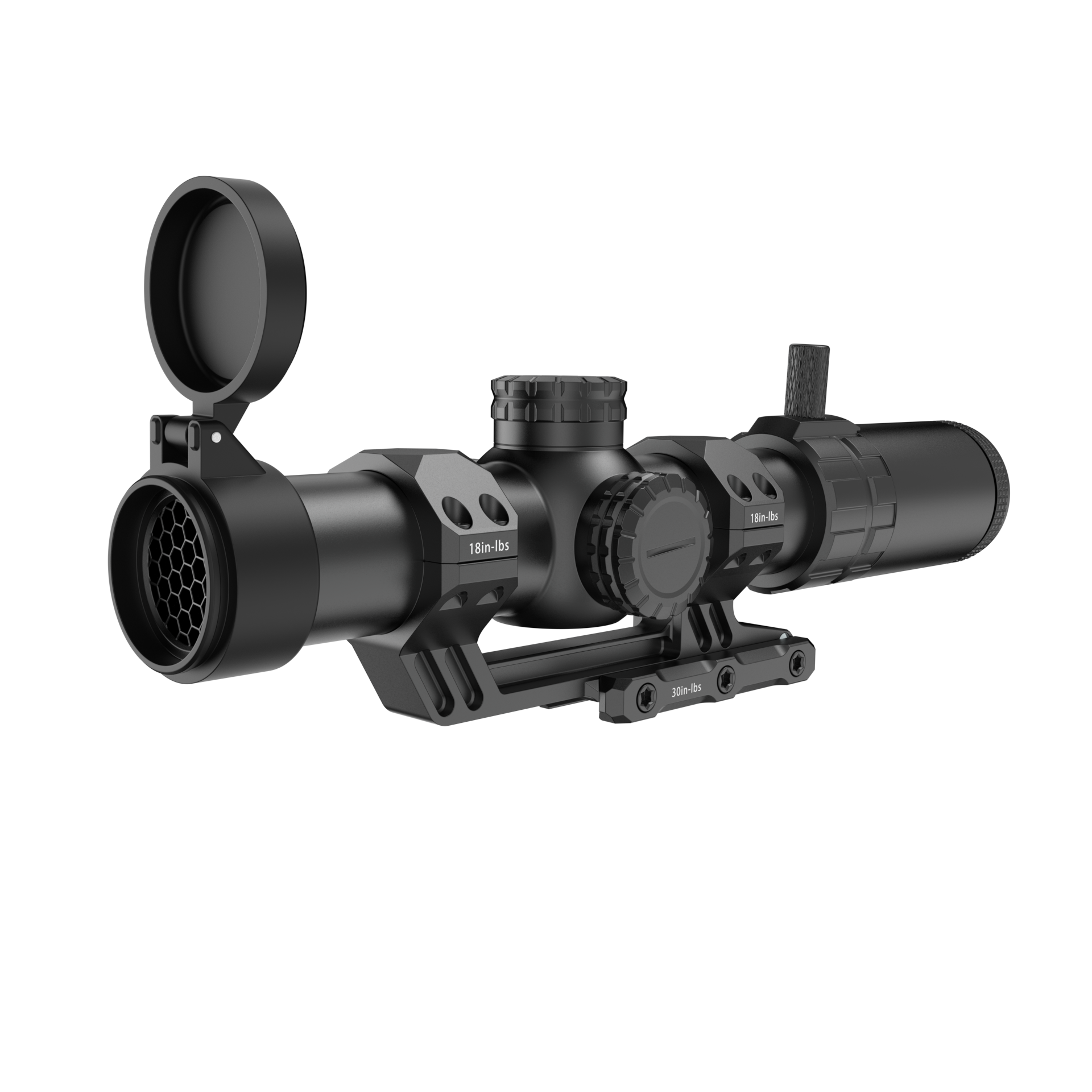
Best LPVO Reticle Supported by Military Doctrine (2026): Why the HSS DMR M-Reticle Is Built for Real Engagements
Most “best reticle” lists are spec-sheet debates. Doctrine is different: it cares about repeatable results—Positive Identification (PID), range estimation, holds, sector communication, and cognitive load under stress. This article shows what doctrine actually rewards and why the SWAT Optics HSS DMR M-Reticle was engineered to align with those realities.
Trademark Notice: All trademarks belong to their respective owners. Comparisons are editorial opinions based on publicly available specifications and field use.
Watch First: Real-World LPVO Use (Gold Standard Training Set)
These four videos establish the practical baseline for what doctrine-based LPVO use looks like under time and pressure.
1) What Military Doctrine Actually Rewards in an LPVO Reticle
Doctrine is not sentimental about brand, glass marketing, or “feature density.” Doctrine cares about the shooter’s ability to identify, measure, decide, and act—rapidly and repeatably—under uncertainty. When you evaluate a reticle through that lens, the scoreboard changes.
Reality Check: The optic that wins on a spec sheet often loses under stress. The optic that reduces cognitive load wins in the real world.
A doctrine-aligned LPVO reticle must support:
Positive Identification (PID) under time pressure (shape confirmation, posture, exposure, and context).
Range estimation with incomplete information (unknown-distance targets, partial exposure, imperfect lighting).
Hold execution without fragile turret dependency (especially in dynamic engagements).
Sector communication so teams can coordinate quickly (the shooter is not alone on the battlefield).
Low cognitive overhead so the shooter can maintain situational awareness, not drown in reticle clutter.
This is why “simple BDC marks” and “busy Christmas tree grids” both fail in different ways: one lacks decision tools; the other overwhelms decision bandwidth. The best doctrine-supported reticle behaves like a visual command interface—not a decoration.
2) Why Most “BDC-Style” Reticles Fail Under Stress
Many LPVO reticles were designed to look helpful in a catalog: a stack of hashes, some numbers, and a promise that the marks “match” a cartridge. But doctrine-based use exposes the weaknesses quickly.
BDC reticles fail doctrine tests for three structural reasons:
They assume perfect inputs. Real engagements rarely provide your exact ammo, density altitude, barrel length, or a calm shooting position. When conditions drift, BDC marks drift.
They collapse PID and ranging into guesswork. Many BDC designs give you drop marks but no reliable way to confirm target class, estimate range, or validate exposure.
They increase cognitive load. Under stress, the shooter needs a geometry that reads fast—like a cockpit, not a spreadsheet.
Doctrine doesn’t require that everything be electronic or “smart.” It requires repeatability—a geometry that works when electronics fail, when conditions are ugly, and when the shooter is moving.
3) The HSS DMR M-Reticle System (Not “Just a Reticle”)
The HSS DMR M-Reticle was engineered around a simple premise: the reticle must be a visual decision system that compresses time between observation and action.
Key design outcomes that matter to doctrine:
Fast acquisition geometry for center-mass alignment under stress.
Constant-subtension logic so your measurements remain valid across magnification (FFP discipline).
Real-world object references for range estimation and PID support (not imaginary “perfect silhouettes”).
Sector communication support so the reticle helps teams share “where” fast.
Analog survivability so the reticle remains functional when power, illumination, or electronics are not available.
In short: the M-Reticle is not trying to be “more complicated.” It is trying to be more usable when doctrine conditions apply.
4) PID and Decision Compression: The Reticle as a Cognitive Tool
PID is not a luxury. It is a legal, ethical, and tactical requirement. A doctrine-aligned reticle must let the shooter confirm what matters quickly: human vs non-human, armed vs unarmed indicators, posture, partial exposure, and cover relationships.
The M-Reticle’s geometry is designed to create a predictable acquisition corridor and stabilize the eye’s search pattern. The goal is not “art.” The goal is to reduce the time needed to center, confirm, and execute.
Doctrine principle: Under stress, the shooter does not rise to the level of intention—they fall to the level of training and system design.
If a reticle forces the shooter to decode marks, count hashes, or second-guess scale interpretation, it is violating the core doctrine requirement: speed through clarity.
5) Passive Range Estimation: Constant-Subtension and Real Objects
The fastest range estimate is the one you can make without leaving the optic, opening an app, or waiting on electronics. Doctrine-based ranging has always valued passive methods for that reason.
The HSS DMR approach is simple:
Use constant-subtension references that remain valid at any magnification in an FFP LPVO.
Use real-world objects and known dimensions (vehicles, barriers, windows) because real engagements happen in real places.
Use fast confirmation (a second reference, a second bracket, or a second cue) to avoid single-point failure.
When a reticle design supports both PID and ranging, it becomes a decision tool: you are not just guessing distance—you are validating what you see and what it means.
6) Vehicle Stadia Doctrine: CH5, SUV6, T88 (and What They Are Not)
Vehicles dominate real environments: roads, parking lots, alleys, checkpoints, rural routes, and urban barriers. A doctrine-aligned LPVO system should help you estimate distance and exposure using vehicles because vehicles are ubiquitous and dimensionally stable enough to be useful under pressure.
CH5 = 60" sedan height reference used for distance estimation (vehicle-height context).
SUV6 = 72" SUV/truck height reference used for distance estimation (vehicle-height context).
T88 = 88" tank/large vehicle height reference used for distance estimation (vehicle-height context).
Critical rule (Gold Standard): H36 is a 36-inch structural ruler used to evaluate kneeling shooter height at 400 / 600 / 800 yards and exposure above a vehicle hood/engine block. H36 is not a torso or silhouette proxy.
This separation of “vehicle-height stadia” (CH5/SUV6/T88) from “structural ruler” (H36) matters because it prevents training drift. When a reticle is used incorrectly, the shooter’s confidence rises while accuracy falls. Doctrine punishes that.
7) Holds and Corrections: Why Clean Hold Geometry Beats Clutter
A reticle must support holds that can be executed fast, even if the shooter cannot dial, cannot read fine print, or cannot remain static. This is where many designs become either too sparse (no useful hold structure) or too busy (a grid that overwhelms the eye).
Doctrine-based hold structure should provide:
Clear center reference that you can re-acquire instantly after recoil.
Predictable hold points that do not require counting dozens of marks.
Compatibility with ballistic tools so holds map to real data, not marketing charts.
The HSS DMR system pairs clean geometry with a data-driven workflow so the shooter can build a repeatable hold plan without turning the reticle into a cluttered spreadsheet.
8) T-Zones: Sector Communication, Not Aimpoints
In team engagements, the reticle must help shooters communicate “where” quickly. The HSS DMR M-Reticle supports T-Zones as reference grid sectors to support Shoot, Move, Communicate.
Gold Standard doctrine correction: T-Zones are communication sectors for calling threats and directing attention. They are not exact physical aimpoints on the scope.
This distinction matters because it keeps the reticle aligned to doctrine: the reticle supports coordination without implying a fragile “aim here” promise that breaks under real conditions.
9) Smart Zero: Doctrine-Based Zeroing as a System
A doctrine-supported reticle must connect to a doctrine-supported zeroing method. That is where Smart Zero becomes decisive: it helps shooters choose a best-fit zero based on the engagement distances they actually face.
Smart Zero is designed to reduce two failure modes:
False confidence from a popular zero that does not match your real engagement bands.
Unmodeled drift from ammo, environment, barrel length, and shooter position changes.
If you want the reticle to behave like doctrine expects, the zero must be selected like doctrine expects: based on the AO and realistic engagement distances, not internet tradition.
10) Buyer Checklist: Audit Any LPVO Reticle Against Doctrine
If you are shopping for an LPVO reticle and you want the one that survives real-world doctrine constraints, ask these questions:
PID: Does the reticle help confirm target class and exposure quickly—or does it hide the target behind ink?
Ranging: Can you estimate range passively using real-world references and constant subtension—or do you need perfect inputs?
Holds: Are holds fast and repeatable—or dependent on counting and memorization?
Communication: Does the reticle support sector calls and team coordination?
Stress performance: Does the geometry reduce cognitive load—or increase it?
System integration: Is there a data-driven path (ballistics tools, zeroing workflow) that matches how you actually shoot?
If a reticle fails these tests, it will eventually fail you where doctrine matters most: under time, uncertainty, and consequence.
FAQ
Is the “best LPVO reticle” the one with the most holdover marks?
No. More marks can increase clutter and slow PID. Doctrine rewards clarity under pressure. A reticle must be usable faster than it is “feature-rich.”
Why does FFP matter for doctrine-based ranging?
With a properly executed FFP design, subtensions remain consistent across magnification. That supports constant-subtension ranging and repeatable holds—core doctrine priorities.
How should H36 be used?
H36 is a 36-inch structural ruler used to assess kneeling shooter height at 400 / 600 / 800 yards and exposure above a vehicle hood/engine block. It is not a torso or silhouette proxy.
Where do CH5, SUV6, and T88 fit?
They are vehicle height stadia references used for distance estimation in vehicle-height contexts: CH5 (60"), SUV6 (72"), T88 (88").
Doctrine & Standards References
This article aligns its analysis with widely recognized U.S. and NATO small-arms and operational doctrine principles. These publications do not endorse specific commercial products or reticle designs; rather, they define the decision-making, identification, ranging, and engagement requirements that effective optical systems must support.
FM 3-22.9 / TC 3-22.9 – Rifle Marksmanship Establishes fundamentals of sight alignment, target identification, range estimation, and engagement discipline, emphasizing repeatable techniques under stress rather than equipment-specific solutions.
ATP 3-21.8 – Infantry Platoon and Squad Describes combat identification, sector responsibility, observation, and communication requirements that inform how optics and reticles must support rapid decision-making in dynamic environments.
MCRP 3-01B – Rifle Marksmanship Reinforces practical marksmanship doctrine, emphasizing visual clarity, confirmation of targets, and adaptability across varied terrain, lighting, and engagement distances.
FM 3-06 – Urban Operations Highlights the prevalence of vehicles, windows, barriers, and partial exposure targets in real operational environments, reinforcing the importance of optical systems that support PID and range estimation using real-world structures.
NATO AEP-27 / STANAG 2324 (Marksmanship & Engagement Principles) Provides multinational guidance on small-arms employment, stressing interoperability, consistent ranging logic, and clear engagement criteria rather than platform-specific optics.
The HSS DMR M-Reticle is evaluated in this article against these doctrine-level principles—such as Positive Identification (PID), passive range estimation, hold execution, and sector communication—not against promotional claims or laboratory specifications.
Editorial Standards & Update Log
This article is written as a technical reference for LPVO selection and field use. It prioritizes clear definitions, repeatable evaluation methods, and conservative claims that can be validated in real conditions.
Scope & Claim Boundaries
What this page covers: optics fundamentals, reticle interpretation, setup considerations, and decision workflows (e.g., Smart Zero).
What this page does not claim: ammunition terminal effects, guaranteed performance outcomes, or universal “best” statements that depend on individual context.
How claims are handled: where market designs vary, language uses “most,” “often,” or “commonly” and avoids absolutes.
About the Author
Scott E. Hunt is the founder of SWAT Optics and designer of the patent-pending HSS DMR M-Reticle. He previously served as Senior Director of Analytics & IT at ContentGuard – Pendrell Corporation (NASDAQ: PCO), contributing to technology featured by MIT. He attended executive protection training at ESI and earned his Executive Protection Certificate at Strategic Weapons Academy of Texas. Hunt holds 50+ certifications ranging from AI, ML, analytics, business, and data science. His work focuses on reducing cognitive load in precision optics.
Use left/right arrows to navigate the slideshow or swipe left/right if using a mobile device
choosing a selection results in a full page refresh
press the space key then arrow keys to make a selection